What Is SkyReels V4? 2026's Latest AI Audio-Video Generation Model Explained
What Is SkyReels V4? A Deep Dive Into Kunlun Wanwei's New AI Audio-Video Model
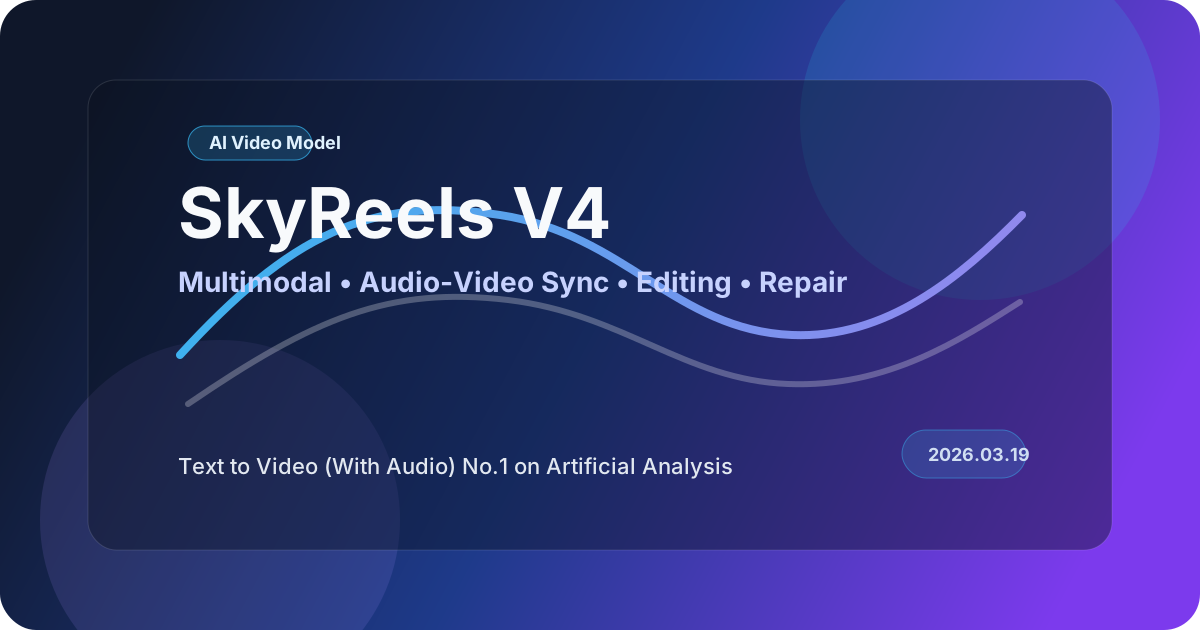
On February 2026, Kunlun Wanwei (Tiangong AI) released SkyReels V4. By March 19, 2026, it had become one of the most talked-about foundation models in AI video: it unifies multimodal input, joint audio-video generation, and video generation / repair / editing in a single framework, and it now ranks No. 1 globally in Artificial Analysis' Text to Video (With Audio) benchmark, ahead of models such as Google Veo 3.1 and OpenAI Sora 2.
If early AI video models were mainly about generating a moving image from a sentence, SkyReels V4 represents a different direction: treating video creation as a complete production workflow rather than a one-off generation task.
SkyReels V4's Core Positioning
SkyReels V4 is not just a text-to-video model. It behaves more like a unified video creation foundation. In a single framework, it can handle:
- Text-to-video
- Image-to-video
- Video editing
- Video repair
- Video extension
- Video super-resolution
- Joint audio-video generation
That means creators no longer need to jump between separate tools. You can use the same prompt language and the same reference assets to move from ideation to generation, then to editing, repair, and expansion.
Why SkyReels V4 Got So Much Attention
1. True Joint Audio-Video Generation
One of SkyReels V4's biggest strengths is that it generates video and audio inside the same framework, instead of rendering video first and adding audio later.
It uses a dual-stream MMDiT architecture, where the video and audio branches work in parallel and align frame-level timing through bidirectional cross-attention. In practice, this matters a lot for:
- Lip sync when characters are speaking
- Matching sound effects to motion beats
- Aligning background music with camera rhythm
- Creating more natural emotional atmosphere
For short dramas, talking-head clips, narrative shorts, and ad creatives, this is a major advantage.
2. More Flexible Multimodal Input
SkyReels V4 accepts more than text. It also supports:
- Text
- Images
- Video clips
- Mask inputs
- Audio references
This makes it feel much closer to a professional post-production workflow. For example, you can:
- Use a character image to control appearance
- Use a reference video to guide motion and pacing
- Use a mask to change only the background or a local area
- Use audio references to shape speech, rhythm, and mood
This kind of multi-condition control moves AI video away from random generation and closer to production-ready creation.
3. Generation, Repair, and Editing in One Framework
Another important idea behind SkyReels V4 is its unified repair paradigm. Instead of training separate models for generation, editing, and repair, it treats many tasks as variations of image/video repair.
This brings several benefits:
- Lower task-switching cost
- More stable output
- Better identity consistency during editing and extension
- More efficient local fixes than full regeneration
For creators, that means "change one part" no longer requires "start over from scratch."
Key Technical Innovations
Dual-Stream MMDiT Architecture
SkyReels V4 gives the video and audio branches their own multimodal diffusion transformer (MMDiT) backbones, then aligns semantics with a shared MLLM text encoder. This keeps both modalities expressive while maintaining a unified intent.
In simple terms:
- Video handles structure and motion
- Audio handles rhythm, voice, and synchronization
- Text serves as the shared intent layer
Unified Repair Paradigm
Through channel concatenation and temporal concatenation, SkyReels V4 merges many tasks that used to be separate. This is especially useful for video editing, local replacement, corrupted frame repair, and removing unwanted elements.
Efficient Generation Strategy
SkyReels V4 also uses a more efficient generation pipeline:
- Generate the full sequence at low resolution first
- Enhance key frames at higher resolution
- Combine super-resolution and frame interpolation to improve final output quality
The goal is not just speed, but a better balance of clarity, smoothness, and stability within reasonable latency.
What Can SkyReels V4 Be Used For?
1. Short Drama and Short-Form Content Creation
Feed it character concepts, dialogue, and story beats, and it can generate short clips with synchronized voice.
Great for:
- Story channels
- Talking-head content
- AI character shorts
- Episode-style mini dramas
2. Video Editing and Repair
A single prompt can handle many post-production tasks, such as:
- Background replacement
- Weather changes
- Watermark removal
- Subject replacement
- Quality restoration
- Clip extension
This is attractive for content repurposing, ad creative refreshes, and legacy video restoration.
3. Content Extension and Style Transfer
SkyReels V4 is also useful for:
- Video continuation
- Style transfer
- Multi-shot composition
- Reference-driven creative reuse
In other words, it's not just good at generating the first version — it's also good at continuing and refining it.
Why It Ranks So Highly
As of March 19, 2026, SkyReels V4 sits at No. 1 in Artificial Analysis' Text to Video (With Audio) ranking. That typically means it performs well across:
- Visual quality
- Motion stability
- Audio synchronization
- Semantic understanding
- Camera behavior
- Multimodal controllability
A model that only makes pretty frames, but can't sync audio reliably or support editing, usually won't stay at the top of this kind of benchmark. SkyReels V4 stands out because it does more than generation — it also handles production workflows.
What This Means for Creators
SkyReels V4 shows that AI video is moving from "single-shot generation" to "controllable production."
For creators, that translates into three immediate benefits:
- Less rework: generate, edit, repair, and extend in the same workflow
- Better consistency: keep character, camera, and audio aligned
- Lower barrier to entry: you don't need a full post-production team to create polished content
In short, future AI video tools will be judged not only by how well they generate, but by how well they support the full workflow.
Frequently Asked Questions
What is SkyReels V4?
SkyReels V4 is a multimodal AI audio-video foundation model released by Kunlun Wanwei (Tiangong AI) in February 2026. It supports text-to-video, image-to-video, video editing, video repair, and joint audio-video generation.
How is SkyReels V4 different from a normal text-to-video model?
A normal text-to-video model usually focuses on the visual output only. SkyReels V4 integrates audio, video, editing, and repair into one framework, making it better suited for a real production workflow.
Why is SkyReels V4 considered so strong?
It stands out in audio-video synchronization, multimodal control, unified editing, and benchmark performance — especially its No. 1 ranking in the Text to Video (With Audio) category.
Conclusion
SkyReels V4 is not just "another AI video model." It pushes AI video from "can generate" to "can produce, edit, repair, and extend."
If earlier AI video tools were mainly for inspiration demos, SkyReels V4 feels much closer to a practical production system. As models like this continue to mature, the line between AI-assisted content and professional workflow will keep shrinking.
For people following the AI video industry, SkyReels V4 is worth watching. For creators, it points to the next generation of video workflows.
Ready to Create Your Own AI Art?
Transform your photos into stunning anime-style images and videos
Try For FreeRelated Articles
What is Seedance 2.0? The AI Video Model That Changes Everything
Discover what Seedance 2.0 is and how this next-gen AI video model by ByteDance delivers native audio sync, multi-shot storytelling, and cinematic camera control.

AI Anime Video: How to Create Animated Videos from Photos (2025 Guide)
Learn what AI anime video generation is and how it works. Turn photos into animated anime videos with movement, camera effects, and dynamic motion using our AI tool.
Seedance 2.0场景大全:导演思维、分镜复刻与7大变现实战
系统拆解 Seedance 2.0 的导演思维与分镜能力,覆盖分镜复刻、二创、现实编辑、带货广告、主体迁移等 7 大场景,并附可复制提示词模板。